
.png%3F2026-01-16T23%3A27%3A35.829Z&w=256&q=75)
.png%3F2026-06-11T10%3A54%3A00.984Z&w=3840&q=75)
You buy a painting you love. The artist is well known in Lagos circles. You paid good money for it, framed it, and it is hanging in your living room.
Three years later, you want to sell it. Maybe you are upgrading your collection. Maybe you need liquidity. Maybe a gallery contacts you because a European collector is interested.
Then comes the question you were not expecting.
"Can you prove where it came from?"
What Provenance Actually Means
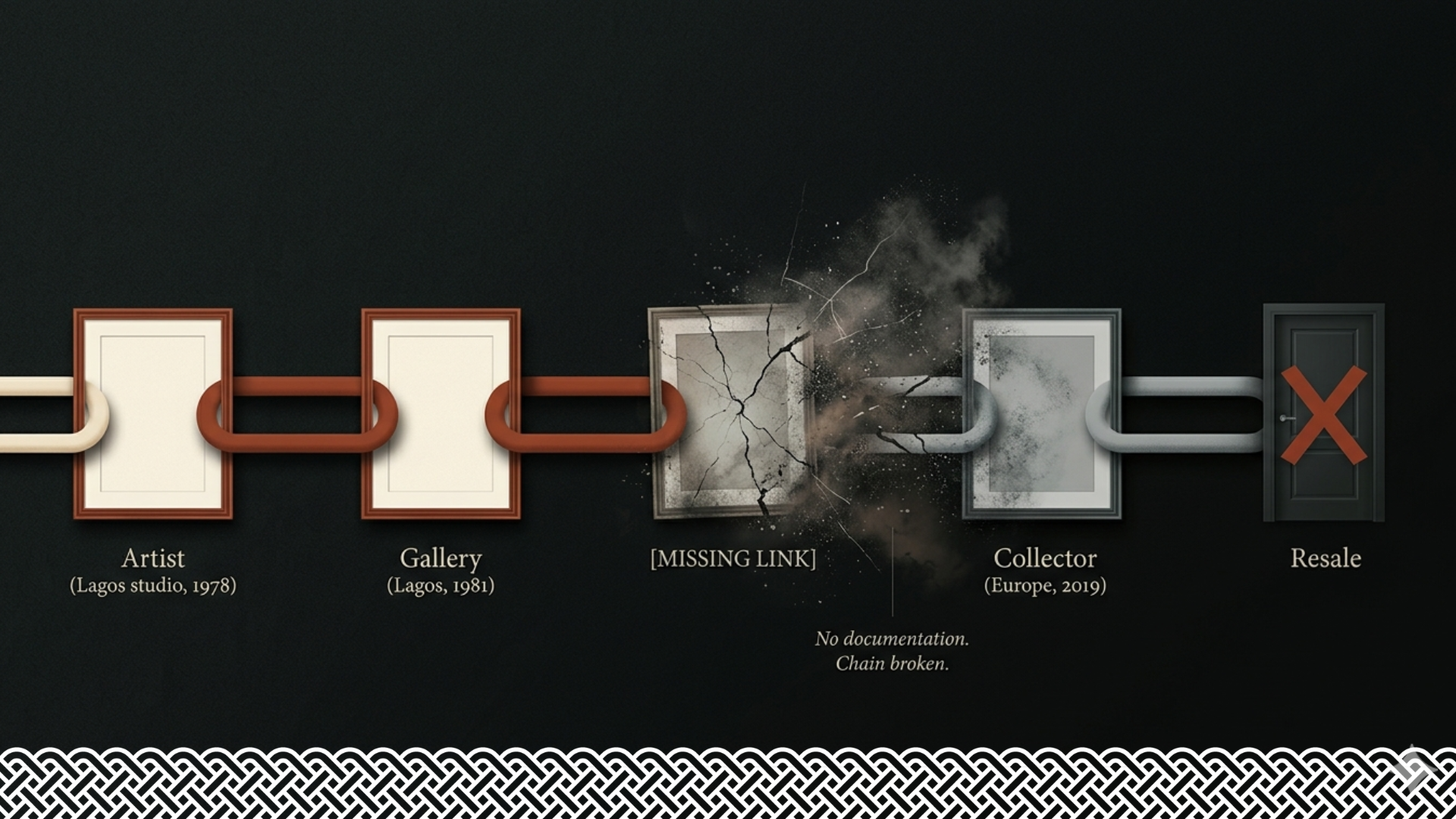
Provenance is the documented history of an artwork: who made it, who owned it, when it changed hands, where it was exhibited, and how it moved from the artist's studio to where it sits today.
It is not a certificate you print out. It is a chain of evidence.
In mature art markets, provenance determines whether a work can be resold at all, what it can sell for, and whether a buyer will even take it seriously. A painting by Gerhard Richter without a clean ownership trail is essentially worthless at auction, no matter how good it looks. The same logic applies in the African art market, even if the infrastructure to support it has barely existed until now.
Why It Matters More for African Art Than Almost Anywhere Else
The African art market has been growing. Auction sales of works by African artists reached $70.5 million globally in 2025, a 43 percent increase from the year before. Contemporary African art has attracted attention from institutions like the Met and Tate Modern. ART X Lagos sells out. International collectors are paying attention.
But the infrastructure underneath that excitement has not kept pace. And provenance is the biggest gap.
Consider what happened in 2025. Sotheby's, which had run a dedicated Modern and Contemporary African Art department since 2016, dissolved it entirely. The department was folded into general contemporary sales. The specialist team was reduced. Dedicated cataloguing and research for African works, gone.
This was described by observers as "low-hanging fruit" in a cost-cutting exercise. That framing is worth sitting with. When an artist from Lagos competes for page space and auction attention alongside Richter, Basquiat, and Hockney, the context that makes their work legible to a global collector disappears. Provenance documentation is part of that context. Without it, the work is harder to price, harder to sell, and harder to defend.
The underlying problem is not that African art lacks value. It is that the systems to prove and transfer that value have been thin, informal, and dependent on the wrong things.
How Provenance Actually Works in Practice Right Now
Here is what the current reality looks like, based on conversations inside the Nigerian art ecosystem.
When an international auction house or a serious collector does due diligence on a work that came through a Lagos gallery, they do not have a registry to consult. They call the gallery owner directly. They ask if the work is genuine, if it came from the artist, if there is any documentation of the sale. Sometimes the gallery owner gets emails like this once a month. Sometimes more.
When the gallery owner cannot be reached, or the gallery no longer exists, or the artist has died, the trail ends there.
In some cases, due diligence teams reach out to university professors or elder figures in the ecosystem, people with decades of institutional knowledge about which artists were active when, what their work looked like in different periods, and who the credible dealers were. This works when those people are alive and responsive. It is not a system. It is a network of human memory, and human memory does not scale.
This is what provenance infrastructure looks like in most of Nigeria right now. Not a database. Not a registry. A few trusted individuals who happen to know things.
.png)
The Ben Enwonwu Problem
Ben Enwonwu is the clearest illustration of what provenance does when it is present.
Enwonwu, who died in 1994, is Nigeria's most celebrated modern artist. His "Tutu" series, portraits of an Ife princess painted in 1973, became a phenomenon. One painting from the series sold for £1.2 million at Sotheby's London in 2019, blowing past a pre-sale estimate of £150,000. Works attributed to him regularly appear at Bonhams and achieve six-figure sums. His auction record sits at over $1.6 million.
That market exists because Enwonwu's career was documented. There are institutional records, scholarly catalogues, gallery histories. When a work attributed to him comes to auction, there is something to verify against.
Now think about the hundreds of talented Nigerian artists from the same generation whose careers were never documented in that way. Artists whose works are sitting in family homes, galleries, and private collections across Lagos, with no paper trail, no registry, no chain of evidence.
Those works cannot move. Not reliably. Not at any price that reflects their actual quality.
This is not a taste problem. It is a documentation problem.
What Happens When There Is No Provenance
When a work cannot be verified, a few things happen.
First, it cannot be insured at proper value. Insurers require documentation. Without it, the policy either does not cover the work at replacement cost, or the collector has to fight a claim.
Second, it cannot be resold through credible channels. Auction houses require provenance history as a condition of consignment. Serious dealers ask the same. The only buyers willing to proceed without documentation are those who are either uninformed or deliberately not asking questions.
Third, the artist loses long-term value. Every resale is evidence that a work has a market. That evidence feeds future pricing, future collector interest, future institutional attention. When the resale cannot happen, that compounding effect never starts.
Fourth, and most directly for the collector: you are holding something you paid real money for, that you cannot sell at a price that reflects its worth, to anyone who will stand behind the transaction.
What Real Provenance Documentation Looks Like
At minimum, proper provenance for an artwork means:
A clear record of who created the work, including the artist's verified identity, not just their name on a label.
A documented record of each time ownership changed hands: date, parties involved, price if available.
Any exhibition history: where the work was shown, when, under whose curation.
A physical or digital certificate that is tied to the artist's verified identity and cannot be forged or duplicated without detection.
The problem with traditional certificates of authenticity is that anyone can print one. A document on gallery letterhead proves that the gallery issued the document. It does not prove the gallery was legitimate, that the artist actually signed off, or that the document was not created after the fact.
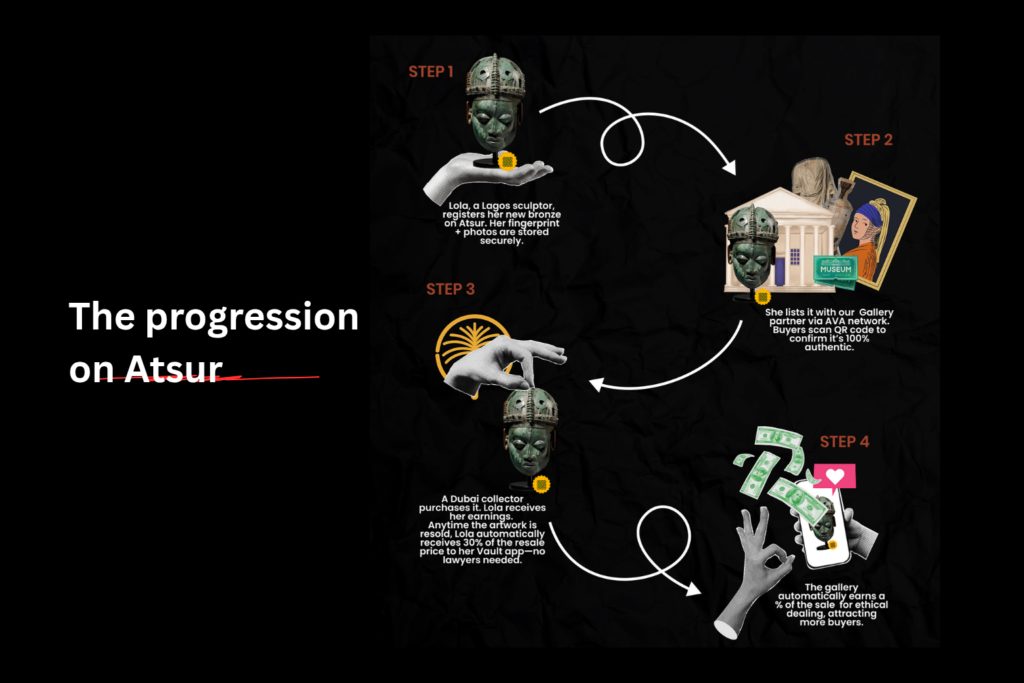
What changes this is linking the certificate to verifiable identity. At Atsur, every artist who registers a work goes through KYC verification tied to government-issued ID. The certificate is not a PDF you can copy. It is a permanent record on a public blockchain, anchored to a real, legally verifiable identity. A collector anywhere in the world can look up the work's history. The record cannot be altered retroactively. And the artist's identity, not just their name, is part of the permanent record.
This is not the future of African art provenance. It is what provenance should have looked like all along.
Why This Matters More Now Than It Did Five Years Ago
The African art market is maturing, which means collectors are getting more sophisticated, and so are the questions they ask before they buy.
A 2026 market update from Bank of America's private banking division noted that buyers are now "deliberate when it comes to quality, provenance, and art-historical significance." That shift is happening globally. It is arriving in the African art market too.
At the same time, the informal infrastructure that African collectors have relied on is becoming less reliable. The galaxy of elder experts who could vouch for works is not permanent. Galleries close. Memories fade. The gallery owner who gets emails from international due diligence teams will not always be available to answer them.
The window to build proper documentation infrastructure is now, while the market is growing and before the gaps become crises.
A Practical Note for Collectors
If you are buying African art today, here is what to ask before any purchase:
Is the artist's identity verified? Not just their name on a certificate, but verifiably linked to an ID.
Is there a documented chain of custody from the artist's studio to the point of sale?
Can the certificate of authenticity be independently verified, without calling the gallery?
Is the work registered anywhere that will still exist and be accessible in twenty years?
If the answer to any of these is no or unclear, you are carrying documentation risk alongside the work itself.
That risk is manageable. But it has to be acknowledged, and it has to be addressed before the moment you want to sell.
Atsur is a provenance infrastructure and IP registry platform for African art. Every work registered with Atsur is linked to a KYC-verified artist identity and anchored permanently on the blockchain. Collectors get a certificate of authenticity that is legally verifiable, independently accessible, and cannot be lost or faked.
Learn more at atsur.art
Sources and further reading:
Artnet News: African art auction sales data 2025 — https://news.artnet.com/market/africa-art-market-shift-2745718
The Art Newspaper: Sotheby's African department dissolved — https://www.theartnewspaper.com/2025/04/24/comment-%7C-trims-to-sothebys-african-modern-and-contemporary-art-department-are-just-one-unwelcome-sign-for-this-previously-healthy-market
CADA Online: A Decade in Review, the African art market — https://www.cadaonline.us/a-decade-in-review-the-african-art-market/
MutualArt: Ben Enwonwu auction records — https://www.mutualart.com/Artist/Ben-Enwonwu/29CF3B5ED3A87E94
Artnet News: Ben Enwonwu Sotheby's 2019 sale — https://news.artnet.com/market/ben-enwonwu-sothebys-london-2019-1680220
Bank of America Private Bank: Art Market Spring Update 2026 — https://www.privatebank.bankofamerica.com/articles/art-market-spring-update.html
MoMAA: African and Diaspora Art Market Outlook 2026 — https://momaa.org/momaa-african-diaspora-art-market-outlook-2026/
TechCabal: Atsur is solving African art's provenance problem — https://techcabal.com/2025/07/24/atsur-art-provenance/